Archived IR presentation for the Second Quarter of the Fiscal Year Ending September 30, 2026
M&A Capital Partners Inc. has posted an archived video of its institutional investor briefing for the second quarter of the fiscal year ending September 30, 2026, held at Tokyo Midtown Yaesu Conference on May 8, 2026.
-
■ Click here for details on Q&A (all questions and answers)
-
In the second quarter, both the number of deals closed and the average deal size remained at high levels. Could you elaborate on the contribution of relatively new consultants and the length of time from joining the Company to their first deal closing?We recognize that even relatively new consultants are making a significant contribution. Nearly half of large deals are led by younger members in approximately their first to fourth year with the Company, typically at the staff or senior consultant level, who have closed around zero to two deals to date. In many cases, they proceed through to closing with support from senior colleagues and supervisors. Being a junior member does not at all preclude strong performance.
The median period from joining the company to achieving the first deal closing is 14 months.As the number of deal closings has increased, the number of active deals has also grown. Could you explain the background to this?The main factors are an increase in the number of consultants and the thorough execution of fundamental activities by each individual. We believe it is particularly important that daily activities, such as increasing the number of client meetings, have become firmly embedded.
There are multiple reasons why the number of active deals has increased despite the progress in deal closings. In general, deal closings reduce the number of active deals. However, for the past two years, we have continued to work simultaneously on acquiring new deals, upgrading existing deals, and closing transactions, and the results of these efforts are now materializing.
In addition, the number of active deals we disclose represents the outstanding balance of active deals, rather than the number of newly acquired deals. Only deals that are actually active are counted, and deals that become stagnant are excluded. Accordingly, we are also pursuing initiatives to reactivate stagnant deals through matching activities. We have previously explained that deal quality has improved while the number of deals remained broadly flat. However, we have also implemented various measures with a focus not only on quality but also on increasing the number of active deals, which has led to the current situation.At the previous earnings briefing, it was explained that resources had been allocated to closing large deals, limiting the resources available for acquiring new deals. Has this situation improved?New deal acquisition and matching activities do not progress at a constant pace, so there are some quarterly fluctuations. However, we are focused on training our consultants and reinforcing their focus on acquiring new active deals. Therefore, we expect these activities to grow over the medium to long term.
In addition, the proportion of large deals remains at a high level, and the absolute number of deals is also increasing. We therefore believe this will contribute to an increase in contract liabilities.Regarding consultant turnover, how does retention, particularly among younger consultants, compare with previous years?The turnover rate is largely unchanged from previous years, averaging approximately 6–7% annually.After remaining flat for some time, the number of active deals increased sharply this quarter. Could you explain the background to this?First, the increase in the number of active deals from 525 at the end of the fiscal year ended September 2024 to 640 at the end of the first quarter of the fiscal year ending September 2025 occurred during a period when we placed strong emphasis on acquiring new deals. However, some lower-quality deals were included at that time. These were subsequently replaced, and as a result, the number of active deals remained flat for a period.
The number of active deals includes not only newly acquired deals but also the reactivation of stagnant deals. If matching activities lead to the reactivation of stagnant deals, the number of active deals increases. Conversely, the number may decrease as a result of closings or stagnation. Therefore, it is difficult to explain fluctuations in the number of active deals by a single factor, as multiple factors are involved.
That said, on a moving average basis, the number of active deals is steadily increasing. We expect it to continue expanding over the medium to long term, supported by the increase in the number of consultants and stronger brand recognition.Regarding consultant recruitment, what measures are you taking amid intensifying competition for talent?The number of candidates applying to the Company has increased, supported by our high average compensation level and enhanced brand recognition. Offer declines are also extremely limited, and our recruitment competitiveness has strengthened. We are targeting a 25% annual increase in the number of consultants, and although our hiring targets are rising, we will continue to recruit only highly capable talent without lowering our hiring standards.Given demographic trends such as population aging and a shortage of successors, do you expect the number of deals that can be matched to continue increasing? Please comment on the market.The market is expanding. At the same time, the competitive environment is changing, with financial institutions such as banks and securities companies increasingly entering the market. We recognize not only industry peers but also financial institutions as competitors. We believe it is important to strengthen our brand and sales capabilities so that clients choose us at the initial point of contact.Are you considering cross-border deals in the future?We would like to pursue initiatives to strengthen our cross-border deal capabilities, including the acquisition of overseas offices or platforms through M&A.The proportion of large deals among active deals currently stands at approximately 24.5%, or about one in four. Is this level based on a strategic target, such as making one out of every four deals a large deal? Also, how do you expect this ratio to trend going forward?The current ratio is the result of our activities and is not based on a strategy of targeting a specific proportion of large deals.
Internally, while we place importance on the number of deals closed, revenue is also a very important factor in consultants’ performance evaluations. As a result, each consultant is motivated to build a track record in large deals and to be involved as an advisor in high-profile transactions that attract social attention. However, such deals are not something that can be intentionally targeted and acquired. Rather, large deals arise as a certain proportion of the broad-based daily sales activities we conduct.
Therefore, we expect the ratio to remain largely unchanged going forward.Were there any notable changes in trends by industry or region in the first half?There were no significant changes.
In the area of business succession, structural issues such as the aging of business owners and the shortage of successors exist regardless of industry. As a result, industries with a large number of companies, such as civil engineering, construction, and real estate, tend to generate a higher number of deals.There is ongoing discussion regarding a review of inheritance tax valuation. Do you expect this to have an impact on business succession?We believe this could have a meaningful impact on business succession. If discussions move forward and reforms are implemented around 2028, conventional inheritance tax planning measures may become less effective, potentially resulting in heavier inheritance tax burdens in some cases.
In such a scenario, M&A may become relatively more important as a means of business succession and may be adopted more frequently as an option. We believe this would have a positive impact on our business.Given the highly profitable nature of your business model, ROE appears to have room for improvement. Improving ROE and thereby increasing the share price and market capitalization could also help expand future M&A options. What are your views?ROE is calculated using equity as the denominator. Therefore, if we can achieve profit growth that exceeds the growth rate of equity, we believe ROE will improve.
We believe there is room to improve ROE this fiscal year depending on progress against our earnings forecast, and we will continue working to maintain strong growth.
For inquiries regarding this notice, contact
M&A Capital Partners Co., Ltd.
Mail:kanri@ma-cp.com
Corporate Profile
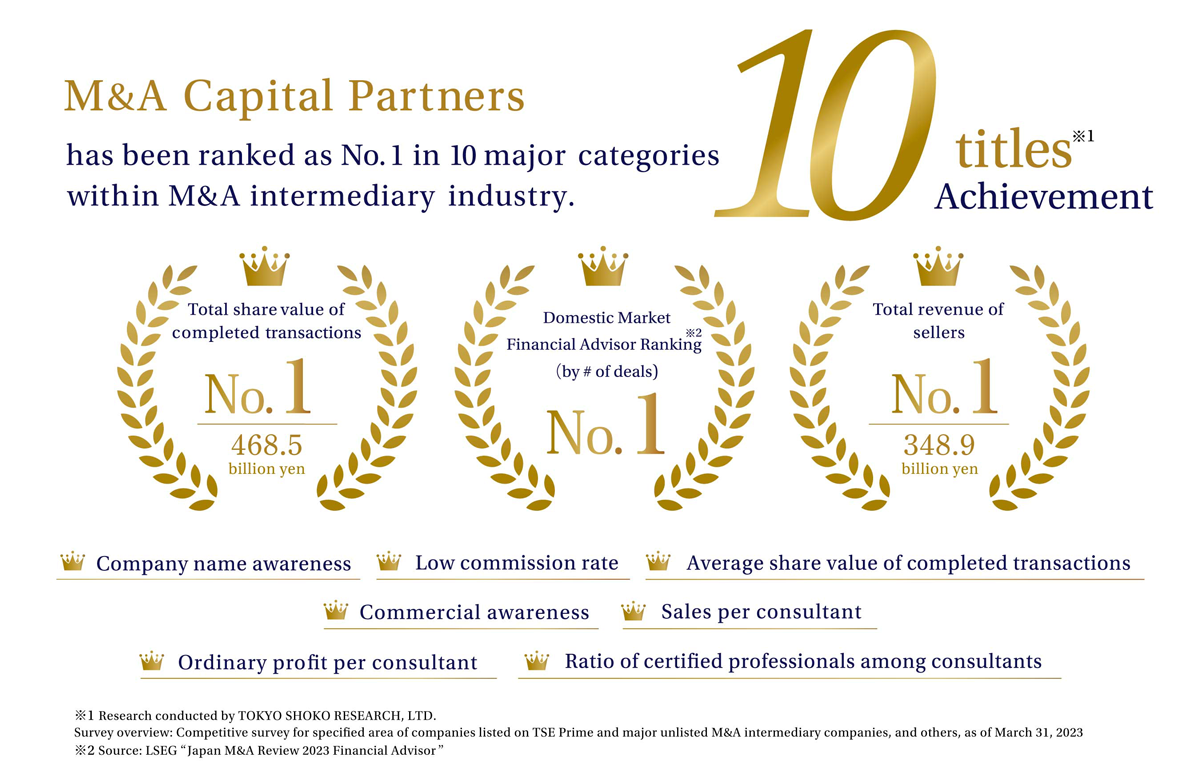
M&A Capital Partners provides M&A brokerage services for small and medium-sized companies.
Ever since the founding of the Company, our concept of “Fair M&A” has been that of a “client-first M&A” that prioritizes the interests of the customer.
Ever since the founding of the Company, our concept of “Fair M&A” has been that of a “client-first M&A” that prioritizes the interests of the customer.
| Company name | M&A Capital Partners Co., Ltd. |
|---|---|
| Established | October 2005 |
| Representative | President Satoru Nakamura |
| Head Office | 36F Yaesu Central Tower, Tokyo Midtown Yaesu 2-2-1 Yaesu, Chuo-ku, Tokyo 104-0028,Japan Phone:03-6770-4300 |